Woven Storage Baskets: A No-Nonsense Buying Guide
Baskets only work if they fit the shelf and the load. Fiber, size, handles, and lining decide whether a set lasts five years or one humid summer.
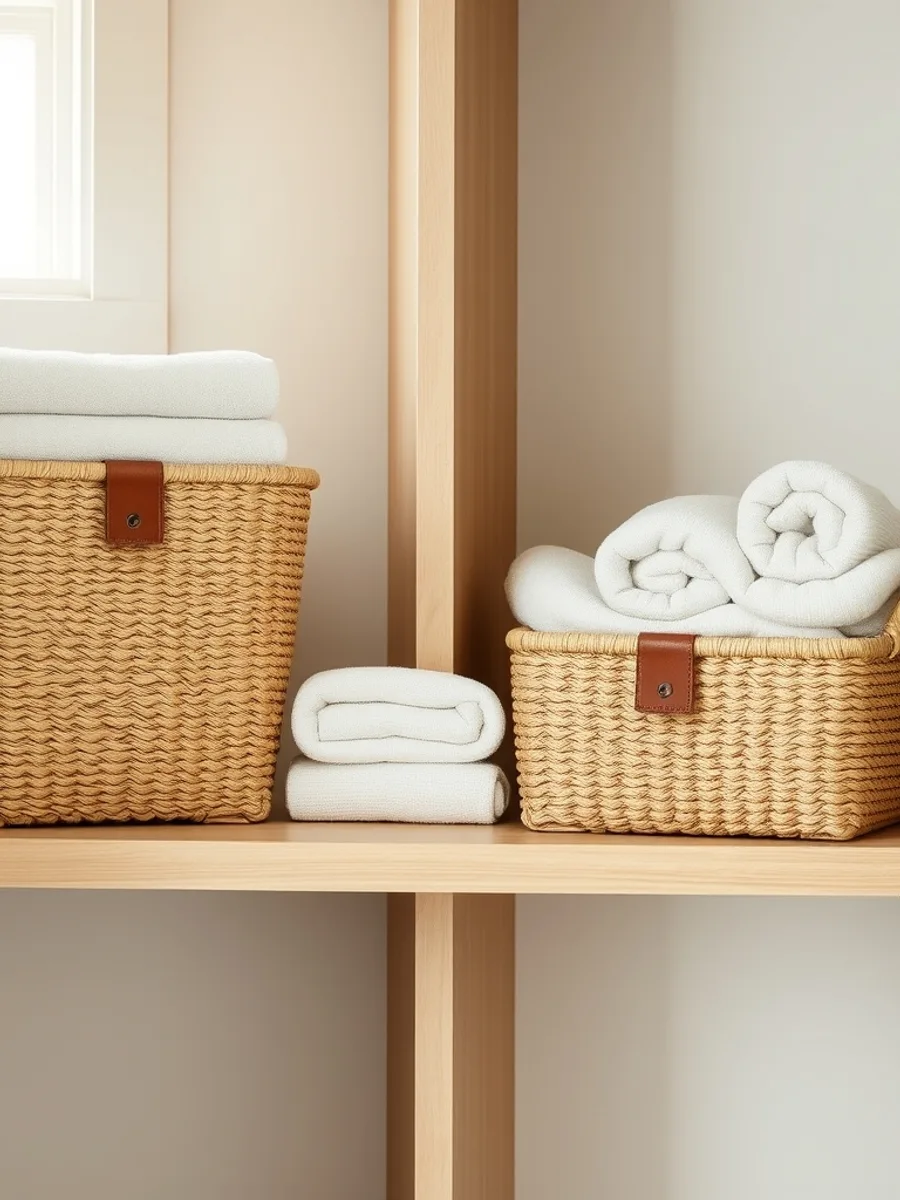
Storage baskets are the most forgiving organizing tool and the most commonly mis-bought. A basket that is two inches too tall will not slide onto the shelf. One made of the wrong fiber will grow a gray bloom in a humid bathroom. And one with flimsy handles will tear the first time it is loaded with towels and pulled out one-handed.
This post contains affiliate links. If you buy through them, we may earn a commission at no extra cost to you. Read our Affiliate Disclosure.
Fiber decides where the basket can live
Seagrass. Dense, stiff, and the most durable of the natural fibers. It holds its shape under load and takes dye evenly. It also dislikes damp: in a bathroom or a basement it can develop mould in the weave, and it is not washable.
Water hyacinth. Softer and more pliable than seagrass, with a slightly shaggy texture. It dries faster and suits bedrooms and living rooms, but it fades in strong sun and the strands can break with heavy use.
Jute. Coarse and sturdy, with a rustic look that suits a mudroom. It sheds fibers for the first weeks and is rough on delicate fabrics.
Rattan and cane. The most rigid and the longest-lasting, and usually the most expensive. Good for a hallway where baskets get dragged.
Cotton rope. Soft, washable, and kind to clothing. It sags under weight and loses shape over time. Good for a nursery or a linen closet, less good for toys.
Recycled PET and felt. Wipe-clean, uniform, and cheap. PET looks convincingly woven from a distance and survives a damp entryway. Felt holds its shape but attracts lint and pets.
Measure the shelf before you admire the basket
Three measurements decide everything: the shelf's depth, the clear height between shelves, and the width you can spare. Then subtract an inch from each. A basket that exactly fills a shelf is a basket you cannot lift out.
Standard cube shelving takes baskets around 13 by 13 inches. Deep shelves in a closet often want 15 to 17 inches front to back. If the basket has leather or rope handles that stick out, add their depth to the footprint, or you will find the basket does not sit flush.
Tapered baskets are easier to pull out and harder to line up. Square baskets maximize volume. Round baskets look better on open shelves and waste corner space. Nesting sets are useful for storage between uses, but the nested sizes are rarely the ones you need on a shelf — check the smallest size before assuming a set of three is good value.
Handles and load
A cut-out handle in a thick woven wall is stronger than a stitched leather loop, provided the weave around it is tight. Leather handles look better and tear sooner if they are only glued. Rope handles stretch.
Think about what the basket will hold. Towels are heavy and compress; toys are light and bulky; cleaning bottles are heavy and awkward. A basket rated for 20 pounds is generous for linens and marginal for a row of glass bottles. If the contents are heavy, choose a basket with a rigid rim, because a floppy rim folds when you lift it.
A fabric liner extends the life of a natural-fiber basket, keeps splinters away from knitwear, and makes the basket wipeable. Some liners are removable and washable; those are worth the extra cost.
Reading a listing without getting burned
Handwoven baskets vary. Two baskets of the same nominal size can differ by an inch in each direction, and the color can shift between dye lots. If the listing gives dimensions, treat them as approximate and check the return policy.
Look for the words "natural," "undyed," or "hand-dyed" and expect variation. Look for a stated weight capacity if the basket is sold for toys or laundry. Look for a liner if the basket is going to hold anything that stains.
Be wary of a strong smell when a basket arrives. Natural fibers can arrive musty from storage; air it in a dry room for a few days. A chemical smell usually means a treatment or dye that has not cured, and it may not fade.
| Product | Best for | What to know |
|---|---|---|
| Seagrass set of three | Closets and shelving | Rigid and durable; check the nested smallest size |
| Water hyacinth with handles | Bedrooms and living rooms | Softer weave; keep out of direct sun and damp |
| Cotton rope basket | Nurseries and linens | Washable, but sags under weight |
| Recycled PET bins | Entryways and mudrooms | Wipe-clean and uniform; less warm than natural fiber |
| Lidded rattan basket | Hallways and hiding clutter | Rigid and long-lasting; lids warp if stored damp |
For a closet, a seagrass basket set of three covers most shelf depths, and water hyacinth baskets with handles are easier to pull out of a deep shelf. In a laundry room, a large woven laundry basket needs a liner to survive wet towels, and fabric cube bins are the practical choice for open shelving in a child's room.
Where baskets actually earn their place
Baskets work when they replace a decision. A basket by the door for shoes removes the daily question of where shoes go. A basket on each closet shelf turns a messy stack into a category. A basket under the bed captures out-of-season bedding without a storage box.
They fail when they hide a category that needs sorting. A basket labeled "everything" becomes a landfill with a lid.
For the shelf systems that baskets fit into, our guide to closet organization basics covers the vertical layout, and laundry room setup explains the sorting flow that a basket should follow rather than interrupt. If floor space is the constraint, under-bed storage shows the low-profile options that fit without blocking a drawer.
The labeling rule
A leather tab, a chalk label, or a card in a sleeve does more for a storage system than a prettier basket. The label survives beyond the first week, when everyone has forgotten what went where.
FAQ
Are seagrass baskets good for bathrooms?
Not ideal. Seagrass absorbs humidity and can develop mould in the weave, and it is not washable. For a bathroom, choose recycled PET, sealed rattan, or a cotton rope basket you can launder, and keep it away from the shower wall.
How do I stop a woven basket from shedding?
A light coat of clear acrylic spray on the outside, applied in thin layers, reduces shedding on jute and water hyacinth. Never spray the inside of a basket that holds towels or clothing. Lining the basket with a washable fabric is the safer fix.
Can woven baskets go in the washing machine?
Cotton rope and some fabric liners can, on a cold gentle cycle. Seagrass, rattan, jute, and water hyacinth cannot: water swells the fiber, the shape distorts, and the weave can rot from the inside. Spot-clean those with a barely damp cloth and dry them fully in the shade.