Gallery Walls: Spacing, Frames, and What to Hang
A gallery wall fails on arithmetic, not taste. How to plan the shape first, space frames so they hold together, and choose hardware that keeps them straight.
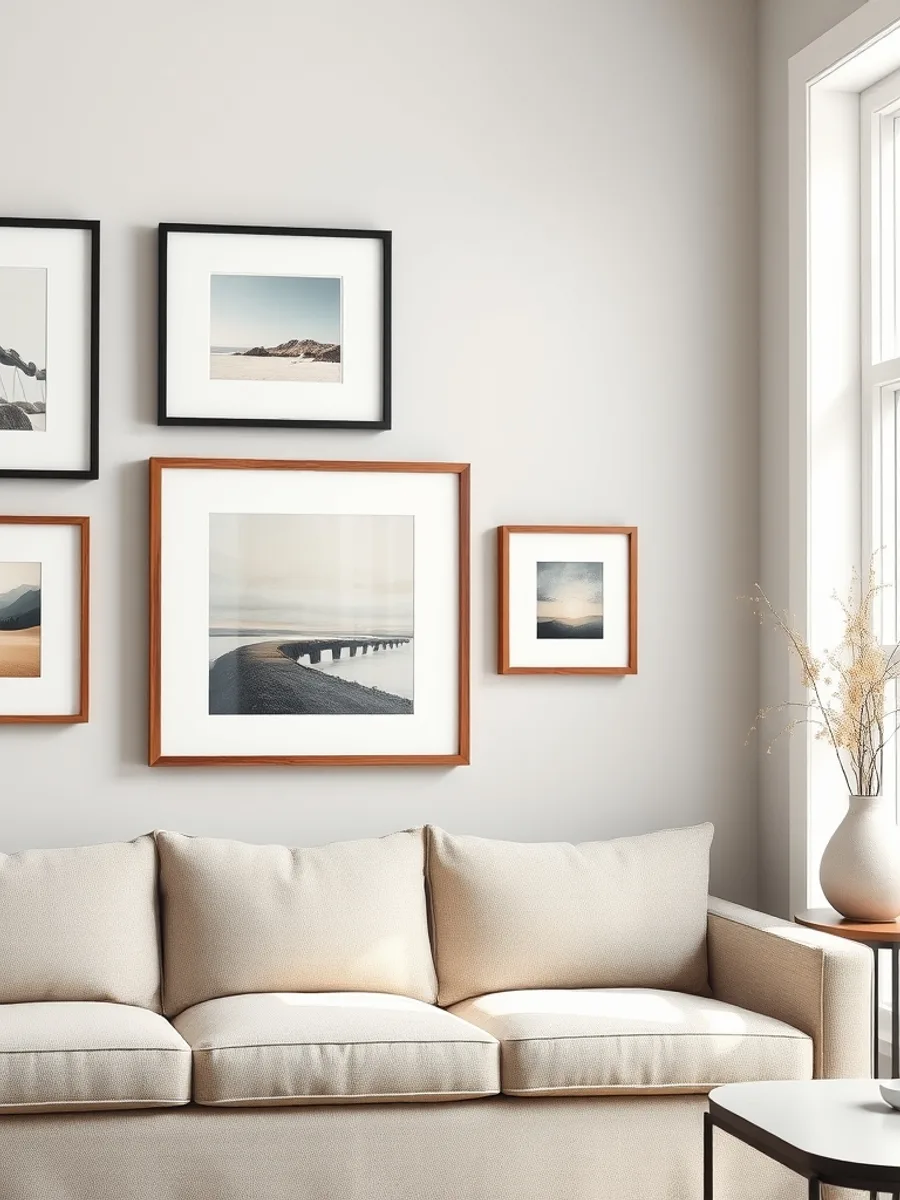
Gallery walls go wrong for a boring reason. People buy frames they like, hang the first one, then add the rest around it by eye, and the result drifts upward and outward until the group reads as a scatter. Spacing and planning are not the creative part, which is exactly why they decide whether the wall works.
This post contains affiliate links. If you buy through them, we may earn a commission at no extra cost to you. Read our Affiliate Disclosure.
Decide the Shape Before the Art
Choose the outline first: a rectangle, a square, a vertical column, or a stair-step that follows a staircase. The outline is what makes a mixed group look deliberate. Within it, the frames can vary in size and color as much as you like.
A rectangle is the safest and the easiest to extend. A square suits a wall between two doorways. A column works in a narrow strip beside a window or at the end of a hallway. The stair-step exists for one reason: frames hung level on a diagonal wall look wrong, so they follow the slope instead.
Measure the wall, then draw the outline at scale on paper. If the group will hang above furniture, include the furniture in the drawing. A gallery wall that stops two inches above a sofa looks like it is floating; one that starts eight to ten inches above the sofa back looks connected to it. In a small room, keep the group narrow enough to leave clear wall on both sides, which is the same restraint that makes small living room layouts work.
Spacing That Holds Up
The standard is a consistent gap of 2 to 3 inches between frames. Consistency matters far more than the exact number. A wall with 2-inch gaps everywhere reads as one object; a wall with mixed gaps reads as several objects that happen to be near each other.
Treat the whole group as a single composition and center that composition, not each frame. On a wall with no furniture below, the center of the group usually sits at 57 to 60 inches from the floor, which is roughly eye level for an adult of average height. Above a sofa, the group center can go higher, because the sofa occupies the lower part of the view.
The gap rule in practice
Cut paper templates for every frame and tape them to the wall. This is tedious for twenty minutes and saves an afternoon of patching. Stand back, sit down on the sofa, and look from the doorway. Adjust the paper until the gaps look even from all three positions, then mark the hook points through the paper with a pencil.
Frames and Mats
The frame is a supporting actor. Thin profiles disappear into a group and let the images do the work; wide profiles are better as a single anchor piece. Mat width changes the apparent size of a print more than the frame does, and a wide mat is the cheapest way to make a small photograph hold a large wall.
| Product | Best for | What to know |
|---|---|---|
| Thin metal frame, 8 by 10 | Small prints in a tight grid | Cheaper, but the corners dent if dropped |
| Solid wood frame, wide profile | One large anchor piece | Heavy, so use two hooks and a wall anchor |
| Frame with a pre-cut mat | Photographs and small drawings | Check the mat opening size, not the outer frame |
| Acrylic-glazed frame | Hallways and rentals | Lighter and safer than glass, scratches more easily |
| Adhesive hanging strips | Renters, small and light frames | Check the rated weight, and never on plaster or wallpaper |
A set of matching frames with white mats is the least risky way to start a grid, because identical outer dimensions let you vary the images without varying the rhythm. If you already own frames in different sizes, a mat cutting kit lets you standardize the openings so the group looks intentional.
Hanging Heights and Hardware
Use two hooks per frame, not one. A single hook on a wire lets the frame tilt forward and slide off level, which is why so many gallery walls look drunk by the second month. Two D-rings set at the same height, hung on two hooks, hold a frame flat against the wall.
For anything heavier than a small frame, use a proper wall anchor rather than a nail in plaster. On drywall, a self-drilling anchor holds far more than its size suggests; on lath and plaster, find a stud or use a toggle. A picture hanging hook and wire kit usually includes the anchors, which saves a second trip.
Height, then light. A frame hung opposite a window will show glare on glass all afternoon; a matte print or acrylic glazing reduces it. If the wall is dark or the room has no ceiling light nearby, a slim picture light mounted above the group does more than adding another lamp to the floor. Our layered lighting plan treats that fixture as accent light, which is exactly its job.
Build the Wall Slowly
Start with three frames, not nine. Live with them for a week, then add. A group that grows in stages ends up better spaced than one assembled in an afternoon, because you see the gaps every time you walk past and you fix them as you go.
Buy the art last. Frames and spacing can be planned in advance; the images can be collected over months from cheap prints, photographs, and pages you already own. A gallery wall of things you chose one at a time will always beat a set bought in a single order, even when the set costs more.
FAQ
How far apart should gallery wall frames be?
Two to three inches is the usual range, applied consistently. Closer than about an inch and the frames read as one cluttered block; wider than four inches and the group stops reading as a group. Pick a number, write it down, and use it everywhere.
What is the right height for a gallery wall?
Center the whole composition at 57 to 60 inches from the floor on an empty wall. Above furniture, measure from the furniture rather than the floor and leave six to ten inches of clearance. The group should feel attached to what is below it, not floating above it.
Can I hang a gallery wall in a rental without nails?
Yes, with adhesive strips rated for the weight of each frame, on smooth painted drywall. They do not hold on plaster, wallpaper, or textured surfaces, and they will remove a patch of paint if the wall was recently painted. Small, light frames are the safe case; anything with glass and a wide frame is not.