Kitchen Lighting: A Practical Layout Guide
A practical plan for kitchen lighting: task light over the work zones, ambient light that flatters the room, and the color temperatures that suit food.
Kitchen lighting gets planned last, usually after the cabinets are chosen, and it shows. A single ceiling fixture throws a shadow exactly where you chop, pendant lights hang too low over the island, and the room looks bright at noon and gloomy at seven. The fix is to plan three layers together and decide the switching before the electrician arrives.
This post contains affiliate links. If you buy through them, we may earn a commission at no extra cost to you. Read our Affiliate Disclosure.
Three layers, one switching plan
Think of the room as three separate jobs. Ambient light fills the space and lights faces. Task light puts brightness on the work surface. Accent light adds depth — a glow inside open shelving, a wash up a wall, a light over a favorite print.
Most kitchens only have the first. Two changes do most of the work: under-cabinet task light along every countertop, and a separate switch for the ambient light so you can run task light alone in the evening.
The switching plan matters as much as the fixtures. Put ambient, task and accent on separate switches or dimmers, and put the light over the sink on the task circuit. If everything is on one switch, you will use the brightest setting for every job and the room will feel like a cafeteria.
Task light where you actually cut
Task lighting belongs between you and the work, not behind your head. For a run of wall cabinets, that means a strip mounted at the front underside of the cabinet, so light falls on the counter rather than the back wall. Mounted at the back, it lights the backsplash and leaves your hands in shadow.
For a typical 24-inch counter, a continuous strip is more useful than a few downlights, because it removes the pools and shadows that make chopping and reading recipes tiring. If you are fitting new cabinets, ask for a routed channel or a shallow valance so the strip is concealed and does not glare into your eyes when you sit at the table.
Under-cabinet light: what to buy
Choose a fixture with a color temperature around 3000K for food and a color rendering index of 90 or above, which is what makes tomatoes look red rather than brown. Warm white at 2700K is cozier but can make a work surface feel dim; 4000K is common in commercial kitchens and rarely flattering at home.
Check the dimming specification before you buy. Many cheap LED strips dim unevenly or buzz, and some need a dimmer matched to the driver rather than a standard wall dimmer. If you are plugging in rather than hardwiring, confirm the cord length and whether the driver is built into the bar or sits as a separate brick that needs a home.
Pendants, ceiling and heights that work
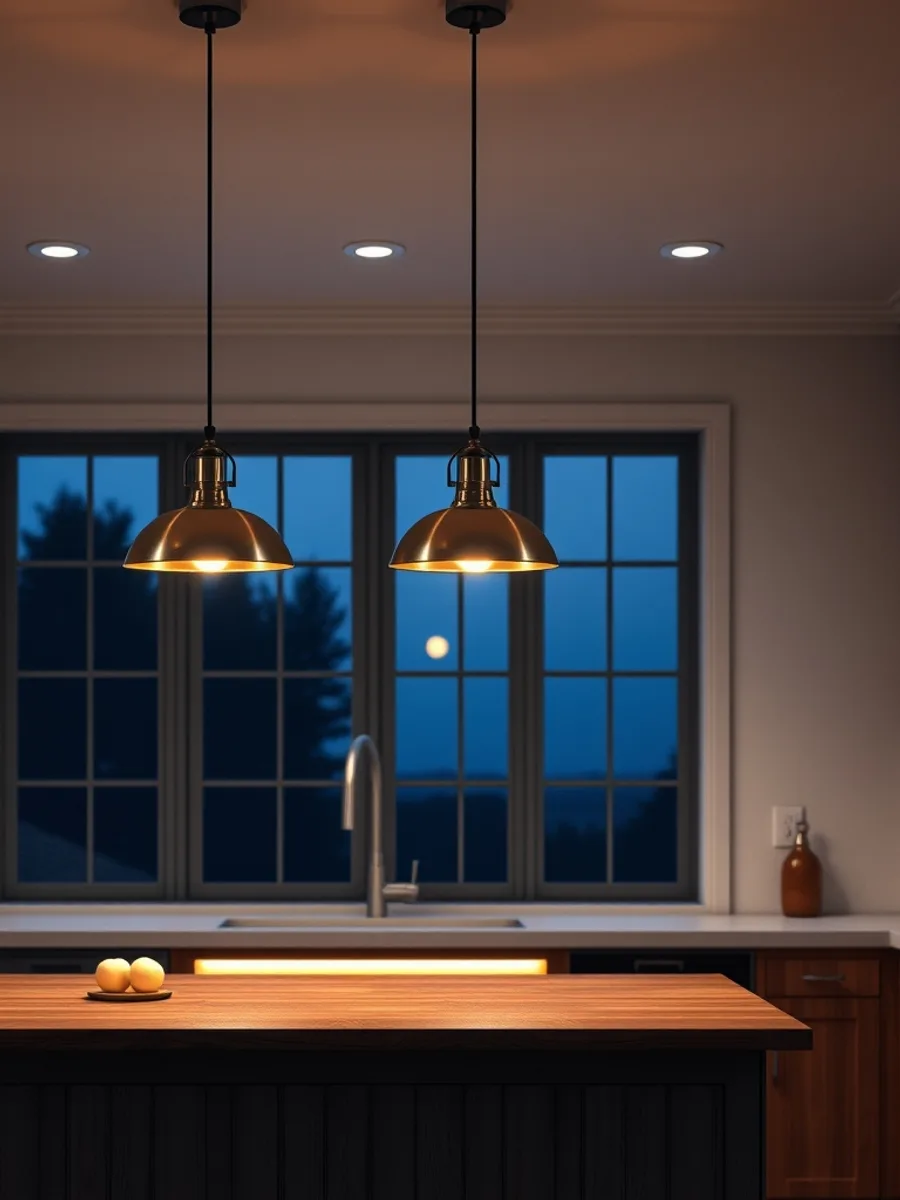
Over an island, pendants are usually hung so the bottom sits around 30 to 36 inches above the counter. Higher than that and they light the room rather than the surface; lower and they intrude on sightlines and get knocked. If the island is the main dining spot, hang them at the upper end of that range and fit dimmable bulbs.
Space pendants evenly along the island and keep them in proportion: two large pendants over a short island look crowded, three small ones over a long island look thin. A useful rule is to divide the island length into equal bays and center a pendant in each, then check the result from the doorway you use most.
For general light, recessed downlights placed in a grid will light the floor and leave the counters dim. Place them over the work zones and walkways instead, and keep them a little away from wall cabinets so they do not throw a harsh scallop of light down the doors. A single central fixture is fine in a small kitchen if the task layer is good.
Color temperature, dimming and the evening problem
Mixing color temperatures in one room is the most common mistake we see. Cool white task light over the counter and warm white pendants over the island reads as two different rooms. Pick one family — we would use 3000K throughout a kitchen — and vary the brightness rather than the color.
Dimming is what makes a kitchen usable after dark. Cooking wants bright, level light; eating wants less; walking through at eleven at night wants very little. A dimmer on the ambient circuit and a dimmer on the task circuit gives you all three without changing a bulb.
If you cannot rewire, plug-in solutions get you most of the way. A warm white under-cabinet light bar with a dimmer is a reasonable starting point, and a plug-in pendant with a fabric cord can hang over a table without an electrician. For fixtures that need bulbs, dimmable warm white LED bulbs with a high color rendering index are worth the small premium, and an adhesive LED strip with a dimmer will handle open shelving or a dark corner of a rented kitchen.
The principles are the same ones that govern the rest of the house, which we set out in layered lighting basics. If the room feels cramped rather than dark, the layout advice in our small kitchen storage guide covers how shelves and light interact, and counter organization explains why a cluttered surface reads as a dim one.
What to check before you commit
- Can ambient, task and accent light be switched separately?
- Is there an outlet or a circuit available inside each wall cabinet run?
- Does the dimmer match the driver, not just the wattage?
- Is the color rendering index stated, or only the wattage?
- Will the pendant clear the sightline from the main doorway?
- Is there light over the sink, the stove and the main prep area?
FAQ
How high should pendants hang over a kitchen island?
Around 30 to 36 inches from the counter to the bottom of the shade is the usual range. Go higher if the island is also the dining table and people sit facing each other; go lower only if the pendants are small and the ceiling is high.
Is 4000K too cool for a kitchen?
It is too cool for most homes. 4000K reads clinical over a dining table and makes skin tones look gray, though it is excellent for detailed work. 3000K is the safer whole-room choice, with 2700K if the kitchen opens into a living area.
Can I add under-cabinet lighting without an electrician?
Yes, if there is an outlet nearby. Plug-in bars and strips with inline dimmers need no wiring, and adhesive mounts avoid drilling. The trade-off is a visible cord run and a driver that needs somewhere to sit, so plan the route before you fix anything to the wall.