Patio Lighting: Layering Light Outdoors
One bright fixture over a table flattens a patio into a pool of glare. Three layers at different heights give it depth, and most run on low voltage.
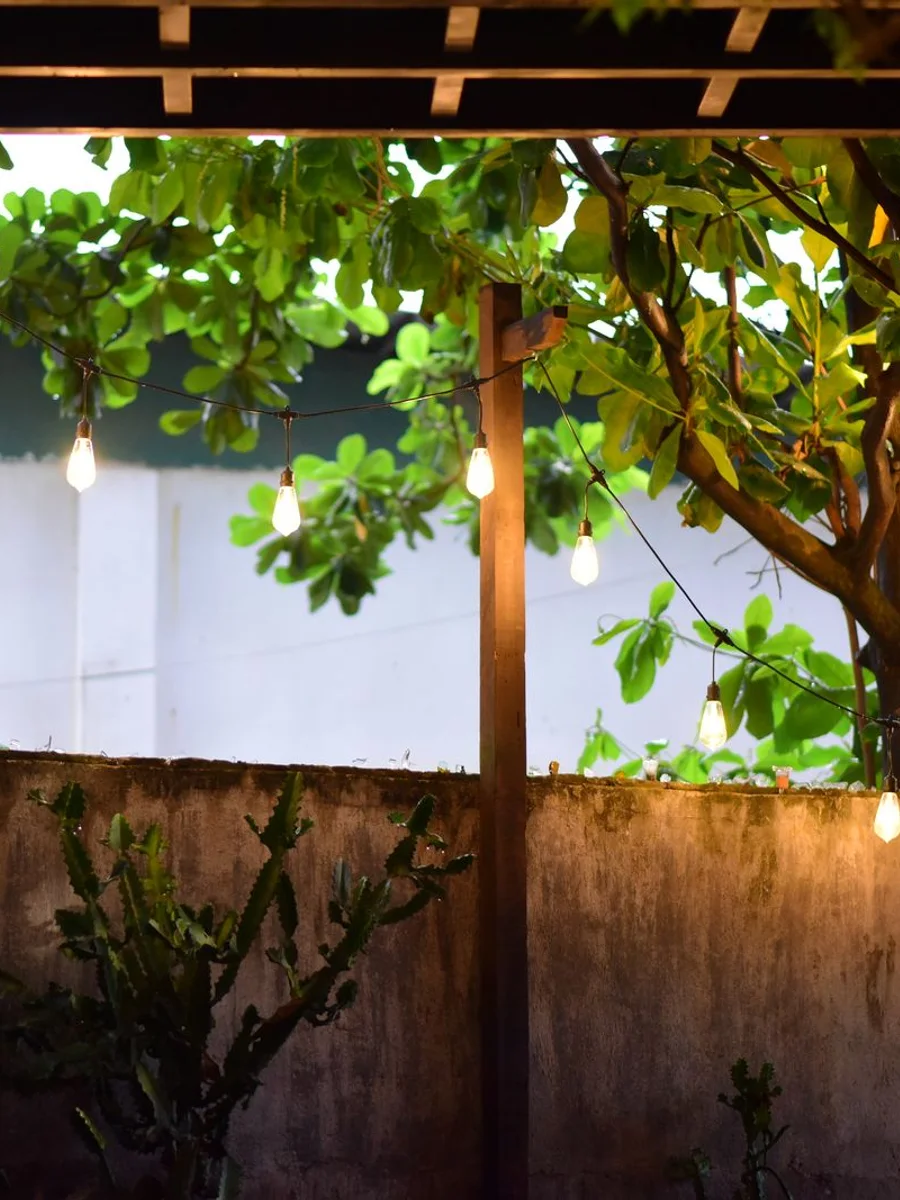
A patio at dusk is a different room from the one you ate lunch on, and most patios are lit as though the only job were to banish darkness. The result is a bright circle over the table, blackness at the edges, and a seating area that feels smaller after sunset than it did at noon. Layering fixes that with three or four fixtures instead of one very good one.
This post contains affiliate links. If you buy through them, we may earn a commission at no extra cost to you. Read our Affiliate Disclosure.
Three layers, three heights
Outdoor light reads as depth when it arrives from more than one height. We think of a patio as having three: overhead, which sets the tone and lights the table; mid-level, at about the shoulder height of a seated person, which lights faces; and low, at ankle or planter height, which marks the edges of the space so nobody walks into a step.
Overhead is usually a string of lights or a pendant under a pergola. Mid-level is a post light, a wall sconce, or a lantern on a side table. Low is a path light, a stake light in a border, or a strip hidden behind a retaining wall.
Few patios need all three everywhere. A 10 by 12 foot patio can work with overhead plus two low fixtures. A larger one needs a mid-level source roughly every ten to twelve feet, or the middle of the space goes dark while the perimeter glows.
Choose warm light outdoors, not white
Fixtures in the 2700K to 3000K range read as warm and slightly amber, which is the quality that makes a patio feel like a room. At 4000K and above, foliage turns a flat blue-green and skin looks gray. If a fixture does not state its color temperature on the box or the listing, keep looking: that number is the most useful single thing to know about it.
Wattage is not brightness. Two fixtures drawing the same wattage can differ by a factor of three in output, which is why lumens is the figure worth comparing. As a starting range, 30 to 50 lumens per fixture at low level and 200 to 400 over a table is workable, dimmed from there once you see how it falls on the ground.
Overhead: the layer that sets the mood
String lights remain the default for good reason. They spread light across a wide area from one circuit, and they can be restrung when you move the furniture. What separates a good set from a frustrating one is mostly mechanical: the wire gauge, which decides how many sets you can join end to end before the far end dims; the socket spacing, which sets how even the wash of light will be; and whether the plugs are sealed for wet locations or merely described as weather resistant.
Hang with slack, and expect the wire to move in wind. A taut line hums, and the anchors take the load. Screw eyes into solid framing rather than into fascia board, and keep the lowest point of the run at least 7 feet above the walking surface.
If you are weighing bulb shapes, set lengths, and plug-in versus solar, our guide to outdoor string lights works through those trade-offs. The harder question of how to arrange seating under them belongs with patio furniture care, which also covers putting things away at the end of the season.
Low: the layer that draws the plan
Low fixtures do work that overhead light cannot. A path light every six to eight feet, set about a foot back from the walkway edge, lights the ground rather than the eye. A single uplight aimed into a tree canopy does more for the sense of enclosure than a second string of lights, because it gives the eye somewhere to look up.
Solar and low-voltage are the two options. Solar fixtures want six or more hours of direct sun on the panel to run through an evening; in shade they fade by ten o'clock. Low-voltage systems need a transformer and cable buried a few inches deep, but they run in shade and last longer. Add up the total wattage on a run before choosing a transformer, and leave about 20 percent of headroom.
Table: light that moves
The most useful addition to most patios is not fixed at all. A rechargeable table lamp or a battery lantern can be carried from the table to the steps to the far corner as the evening moves, and two or three clustered at different heights on a side table look deliberate rather than improvised.
Check the quoted runtime against how long you actually sit outside, and check whether the battery is replaceable. A sealed cell turns an otherwise serviceable lamp into waste in a couple of years. Anything left out overnight should be rated for it, and portable fixtures should come in during storms unless the listing says IP65 or better.
What to check before you buy
- IP rating. IP44 tolerates rain from above. IP65 tolerates hosing and heavy weather. Unrated fixtures belong under a covered porch only.
- Color temperature. 2700K to 3000K anywhere near seating, and consistency across fixtures matters more than the exact number.
- Lumens, not watts. Compare output directly, then plan to dim it.
- Control. A plug-in dimmer or a smart plug on a schedule does most of what an expensive system does for a fraction of the wiring.
- Replaceable parts. Bulbs, batteries, and gaskets should still be obtainable in two years.
A set of warm-white outdoor string lights covers the overhead layer, and low-voltage path lights with a transformer handle the low one. A rechargeable outdoor table lamp is the piece that gets used most in our experience of these setups, and a plug-in dimmer makes a fixed set behave like a considered one.
FAQ
How many feet of string lights do I need for a patio?
Measure the route the wire will take, including any zigzag between posts, then add about 10 percent for slack and sag. Socket spacing of 18 to 24 inches gives an even wash of light; wider spacing reads as a row of bright points rather than a layer.
Can outdoor lights stay up through winter?
Most outdoor-rated sets can, provided the plugs stay off the ground and the wire is supported. Cold makes PVC jacketing brittle, so avoid moving or re-tensioning a set in freezing weather. Solar fixtures need their panels cleared of snow or they will not charge.
Do solar path lights work on a shaded patio?
Only marginally. A panel in open shade may collect enough to run two or three hours, which is usually not enough to make the path legible. Low-voltage or battery fixtures are the better answer for shaded yards, or mount a small solar head somewhere that does get direct sun.