How to Style Open Shelves Without Clutter
Open shelves fail when they hold everything at once. A practical method for deciding what goes up, how to group it, and when closed storage is the better answer.
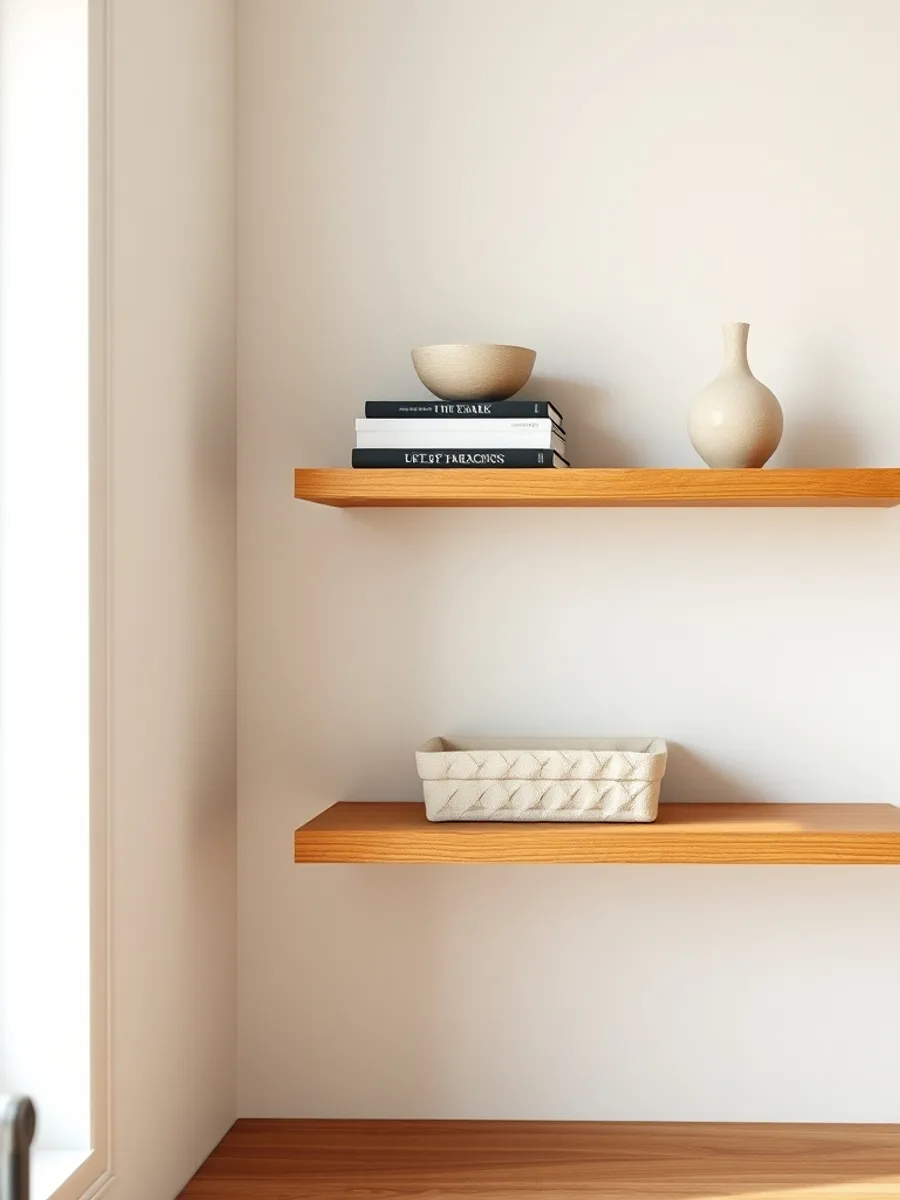
Open shelves are honest. Everything on them is visible, which is either the point or the problem, depending on how much you own. Most open shelving looks worse six months after installation than on the day it went up, not because the shelves were a mistake, but because nobody decided what they were for.
This post contains affiliate links. If you buy through them, we may earn a commission at no extra cost to you. Read our Affiliate Disclosure.
Decide What the Shelf Is For
A shelf does one of three jobs: it stores things you use, it displays things you like, or it does both. The mistake is trying to make one shelf do all three at once without a plan, which produces the familiar parade of half-used mugs, a candle, and a stack of paperbacks nobody reads.
In a kitchen, decide whether the shelves are your everyday dish storage or a display for the good pieces. If they are storage, everything on them should be used weekly. If they are display, keep the working dishes behind a door. Mixing the two is what makes open shelving read as unresolved.
In a living room, the same rule applies with books. A shelf of books you reread is storage. A shelf of books arranged by color is decoration, and it is fine as long as you admit it and do not need to find anything quickly.
The Rule of Three, Loosely Applied
The old advice is to group objects in threes. What matters is not the number but the variation: a group reads as intentional when it contains something tall, something low, and something with a different surface. Three identical vases in a row read as inventory.
Work along one shelf at a time and alternate the rhythm. A vertical stack of books, then a horizontal group of three, then a single bowl. Vertical, horizontal, single. That alternation gives the eye somewhere to travel and prevents the flat, evenly spaced line that makes shelves look like a store display.
Leave roughly a third of each shelf empty. This feels wrong while you are doing it, and it is the single change that separates styled shelves from full ones. Empty space is what lets the objects on either side register as chosen.
Books, Bowls, and the Gaps Between Them
Books do the heavy lifting because they are uniform enough to stack and varied enough to look human. Stack three to five horizontally, or stand them upright and use two as bookends for a shorter run. Always leave one stack with something on top of it, a small bowl or a folded cloth, so the stack reads as a surface rather than a pile.
Bowls and boxes are the closers. A low stoneware bowl anchors the end of a shelf and catches keys or rings in a hallway. A linen-covered archive box hides the cables and small clutter you do not want to look at, provided the shelf is deep enough for the lid to open.
| Product | Best for | What to know |
|---|---|---|
| Low stoneware bowl | Anchoring the end of a run | Check the base diameter; a wide bowl crowds a narrow shelf |
| Linen-covered archive box | Hiding cables and small clutter | Measure shelf depth before buying, lids need clearance |
| Small ceramic vase | Adding height between books | Hollow bases tip on a top shelf, weight matters |
| Wood or stone bookends | Holding a short stack upright | Match the weight to the number of books |
| Shallow woven basket | Remotes, keys, and other small items | Natural fibers shed, line the base with felt |
Two more pieces earn their place on most shelves: a small ceramic vase for height, and a shallow woven basket for the things that have no other home. Both should be wider than they are tall. If a shelf sits beside a hung print, the two need to relate; gallery wall spacing covers how much air to leave between a frame and the objects below it.
When Open Shelving Is a Mistake
Open shelves in a kitchen are a design decision with a maintenance cost. They collect airborne grease, and grease binds dust, so a shelf near a stovetop needs wiping far more often than a cabinet door does. If you cook with high heat and oil most nights, that is an argument for glass doors, not for more shelves.
They also remove your ability to hide. Every mismatched mug and every plastic container is on display. If your dishes are a collection of hand-me-downs rather than a set, open shelving will make that obvious to you every morning. That is not a reason to avoid it forever, but it is a reason to start with one short run rather than a whole wall. Where the space is tight and the visibility is not worth the upkeep, our notes on small kitchen storage cover the closed alternatives.
The grease problem, in practice
Distance is the main variable. Shelves within a couple of feet of a stovetop will need a degreasing wipe weekly; shelves across the room can go a month. Keep the most-used items on the lowest shelf, where they are easy to reach and easy to wipe around, and put the decorative pieces higher where they gather less.
Edit, Then Stop
Styling is subtraction. Put everything you think you want on the shelf, live with it for a week, then remove one object from each shelf. The result is almost always better, and the removed pieces can go in a cabinet for a month to see whether you miss them.
Photograph the finished shelf on your phone. A photo flattens the arrangement the way a guest will see it, and it makes repetition and crowding obvious in a way that standing in front of the shelf does not. If two objects are the same height and the same color, one of them is redundant.
FAQ
How do I stop open shelves looking cluttered?
Give each shelf one job and leave roughly a third of it empty. Group objects in odd numbers with varied heights, and keep anything you use daily within easy reach. If a shelf holds both display and storage, put the storage in matching containers so the eye reads a single block.
Are open shelves practical in a small kitchen?
They can be, if you own a limited, matching set of dishes and cook at moderate heat. Otherwise the maintenance and the visible mismatch outweigh the convenience. A single short run above a counter is a reasonable compromise, and it is easy to reverse if it does not work.
Should shelf decor match the room's color scheme?
It should relate to it, but matching exactly is what makes shelves look staged. Pick one repeated material, such as wood or stoneware, and let the rest vary. A shelf where every object is the same color has no focal point, and the eye slides past it.